
Lakes News:

National News

Scheme to give farmers certainty
Fonterra is piloting a new ‘Guaranteed Milk Price’ (GMP) scheme that will provide farmers with the opportunity to have more certainty in their milk price.

The pilot will mean farmers can choose to lock in a milk price announced at the beginning of a season for up to 75 per cent of their milk supply.
Fonterra’s Managing Director of Group Optimisation and Supply Chain, Ian Palliser says the past few years have confirmed that volatility in commodity prices is here to stay.
“We recognise that every farming business is different. And while most farmers can live with the market volatility, there are times when some farmers would prefer more certainty as it would help them manage their own farming businesses,” Mr Palliser says.
“Certainty can be particularly important for farmers at times when they are considering investing in new equipment, expanding or undertaking a new conversion. It’s a bit like having a fixed interest rate on your mortgage versus a floating rate. It enables you to know exactly where you stand with a percentage of your production and this can help with future planning.
“As well as providing farmers with the certainty they are looking for, GMP also has benefits for the Co-op. That’s because we know what a certain proportion of our milk will cost us for the season and this in turn provides us with another selling tool when talking to our customers, some of whom are also looking for price certainty.
“We have been talking to farmers and the Shareholders’ Council about the GMP concept and we’re now inviting farmers to take part in the pilot scheme that will run over the next season.”
The Co-op will run the pilot for the 2013/2014 season with interested farmers who will have a proportion of their production set at the opening milk price which will be announced in May.
Like converting from a fixed to floating interest rate on a mortgage, there will be a break fee for any farmer who decides to revert back to the normal milk price system during the season.
Mr Palliser says that the pilot would ideally involve around 200 farmers throughout the country, at different stages of their farm operations and with varying herd sizes.
“We will monitor the pilot over the next season and provide feedback to all shareholders on the benefits and the risks and this way farmers can see if it is something that might suit them in the future.”
Council prepare Waikato river for drought disaster
 A barge will be moved on to the Waikato River tomorrow (17 April) as an initial step in preparation for very low river levels still forecast for early May, despite rainfall this week.
Hamilton City Council is taking the precautionary step as part of its contingency plan during the current drought in case promised rain does not ease pressure on low flows from Lake Taupo and in the Waikato River.
The Council has been working closely with Waikato Regional Council, other large water users, iwi and health and civil defence organisations to ensure planning and contingency plans are robust.
The barge will be tethered below the Peacockes Road treatment plant in preparation for pumps being installed next week, ahead of possible use in early May should drought conditions persist.
The pumps will be able to draw water from lower in the river than the treatment plant’s current intake, and the water will then be treated at the plant and reticulated to the city in the usual manner.
City Waters manager Tim Harty says: "While rain is forecast, as part of our contingency plan we’re allowing for a worst case scenario in case it doesn’t amount to much and river and lake levels continue to drop.
"At this time, early May is when the lake is forecast to be at low level and when the river will revert to its natural flow. If significant rain does fall in the lake and upstream river catchments this will extend this date further into May."
The barge will be assembled at the Grantham St boat ramp tomorrow morning in preparation for being lifted by crane on to the river around lunchtime, then towed a short distance upriver to the treatment plant.
Water restrictions for Hamilton are presently at Alert Level 2 - alternate day sprinkler use 6-8am and 6-8pm - but may need to be increased to manage water demand in the event the pumps are required.
To date around $15,000 has been spent on the contingency plan, it will cost around $60,000 to get the barge and pumps in situ, and cost around $30,00-60,000 a week to operate.
The low river level contingency plan, developed in 2008 when there were similar concerns, was not required, however in 2010 the barge was put in place, but again not activated as the rains came.
Tough times but heaps of Jobs
 With 14 unfilled vacancies on Federated Farmers’ own ruraljobs.co.nz website and with almost 150 more listed on other websites, things may be tough on-farm but farmers are still recruiting.
"Federated Farmers’ ruraljobs.co.nz website has 14 unfilled vacancies on it right now," says Conor English, Federated Farmers Chief Executive Officer.
"You can definitely see a North/South split with just two of these 14 roles in the North Island. Whatever the environment and whatever the economy, Kiwi farmers will always need good keen workers.
"I had a quick look at TradeMe and 79 of their 126 farming jobs are in the South Island and of those 126 roles, 72 were paying $50-100,000 with four over $100,000.
"We need to knock a myth that farming roles are low-skilled and low paid.
"Federated Farmers will soon be able to flesh out the pay and benefits farm workers receive with our 2013 Farm Remuneration report nearing release.
"We have been motivated to raise our head above the parapet because we have heard of several hundred Aucklanders queuing for a couple of jobs packing shelves. Federated Farmers wants to say loudly and proudly; have a look at farming.
"So do look at the employment websites and for a real green job, check out Federated Farmers’ ruraljobs.co.nz," Mr English concluded.
Fonterra lifts payout as profit surges
 Fonterra Cooperative Group, the world's biggest dairy exporter, expects to pay 30 cents more to farmers
The Auckland-based company will pay $5.80 per kilo of milk solids and expects to pay an annual dividend of 32 cents per share, meaning a fully-shared up farmer will get a cash payout of $6.12 this season, down from $6.40 last year.
Net profit climbed to $459 million in the six months ended January 31 from $346 million a year earlier.
Fonterra firmed up annual earnings guidance to between 45 and 50 cents per share, from a previous range of between 40 cents and 50 cents.
"The new forecast reflects a recovery in global dairy commodity prices over the past two months," chairman John Wilson said. "World dairy trade growth is being led by powders (combined whole milk and skim), reflecting strong demand at a time when global supply is constrained."
Prices on Fonterra's GlobalDairyTrade auction site have jumped 27 per cent since February when the dairy company's board last reviewed the payout, with New Zealand's supply limited by the worst drought in the North Island for almost seven decades.
Chief executive Theo Spierings said the strong first half is unlikely to be repeated in the second half of the year, with annual milk volumes expected to be in line with last season. Fonterra had previously estimated 1 per cent growth, having already trimmed expectations from 6 per cent growth due to the drought.
"The ongoing volatility in commodity markets could have a negative impact on product mix profitability," Mr Spierings said. "In many of our consumer markets we are expecting intensified competition in the second half - particularly in Australia - and in Asia we are seeing signs of demand slowing."
The profit gain was in spite of a 6.9 per cent fall in sales to $9.33 billion, as the strength of the kiwi dollar eroded increased export volumes.
Waikato farmer picked as new Ballance chairman
 Waikato farmer and businessman David Peacocke has been elected as Chairman designate of Ballance Agri-Nutrients Limited, set to replace David Graham who will retire from the board in September after 10 years as Chairman.
Mr Peacocke, who joined the board in 2005, was elected to the new position by fellow directors at the company board meeting in late February. He and his family are based in Raglan on their beef property and he has interests in several large family farming operations.
The Peacocke family farmed cattle up until about 20 years ago when they transitioned to a mixed operation which now includes dry stock, dairy and cropping in both the Waikato and Canterbury regions. The family are long-standing customers and shareholders of Ballance and its predecessors, and Mr Peacocke’s father Frank also served as a director on the Bay of Plenty Fertiliser Co-operative then Ballance board from 1991 to 2005.
Ballance Chairman David Graham said that the company opted to appoint a Chairman designate in acknowledgement of the importance of the role and the size and scope of the co-operative.
One of New Zealand’s top 50 businesses, total revenue for Ballance in its last financial year to 31 May 2012 exceeded $900 million, resulting in a $77 million trading result and an average rebate and dividend payment of $44.29 per tonne to its 18,000 farmer shareholders.
"The Board has been working through the process to select a new Chairman over the last six months. We now have a further six months during which introductions and handovers will occur to ensure a seamless transition. Our relationships with everyone from our suppliers to our shareholders are extremely important to our company, and the process will mean David will hit the ground running when his official duties commence after the company’s annual meeting on 25 September this year," said Mr Graham.
As 2004 Supreme Award winner in the Ballance Farm Environment Awards for the Waikato region, Mr Peacocke is more than familiar with the challenges facing farmers and sees Ballance playing an increasingly important role in their ability to overcome them.
"Farmers are constantly juggling the need to meet rising environmental expectations with the need to increase production and do it profitably. Ballance has evolved to meet these needs with the full range of nutrient products and advice, and will continue evolving as farming does to keep our shareholders and customers ahead of the game. We’re entering into a new era and I am looking forward to contributing in my new role as Chairman," said Mr Peacocke.
"I couldn’t think of a more exciting time to be part of the Ballance co-operative as we bring the recently acquired farm technology and animal nutrition businesses into the fold and increase the breadth of the value-add products and services we offer to our shareholders."
He says Ballance is the epitome of a modern co-operative, proactively advocating on behalf of shareholders when regulatory changes have the potential to impact farming, and investing significant sums in research and development to keep farms productive, profitable and sustainable.
Mr Peacocke holds a Bachelor of Commerce (Agriculture) from Lincoln University.
Organic certifier points for growth

The organic sector has grown 25 per cent in the past three years - from $275 million in 2009 to $350 million in 2012. The export and domestic market for New Zealand organic products has grown on average 8 per cent a year at a time of global recession.
BioGro’s CEO Dr Michelle Glogau says the report, funded by the organic sector umbrella group Organics Aotearoa New Zealand (OANZ) is a really positive sign of the increased demand for organics amongst consumers. ‘It supports the trends we are seeing with dramatic growth in certified wine and extension into health & body care products’.
Dr Glogau explains that international research consistently shows that consumers are motivated to buy organics for a wide range of reasons: local/seasonal production, their health, animal welfare, the environment, GE free and social responsibility. ‘Our certification logo symbolises all of these things’.
Chair of OANZ, Brendan Hoare says that the market report confirms that ‘more producers are seeing the value of being certified organic which is in line with global trends. They know it’s what their customers want’.
BioGro certifies around 700 organic producers with over 1000 operations around New Zealand. Despite the current economic recession, the amount of land now certified as organic in NZ has increased to 106,753 hectares according to the report.
‘It is really valuable for the organic sector to have its success substantiated by independent research’ Mr Hoare adds.
One of BioGro’s biggest roles is to give organic producers access to international markets which are regulated i.e. organic producers must be independently certified before selling their products off-shore. Dr Glogau explains that the report helps organic producers identify potential market opportunities and highlights that certain export markets have grown for organic products, especially in Asia.
Researchers from the University of Otago and Agribusiness Group who researched and wrote the report for OANZ found that some organic sectors have grown significantly more than others.
• Organic wine has been the fastest growing production sector in the past three years. There are now over 100 organic vineyards, representing 7.6% of all vineyards in New Zealand.
• Organic dairy continues to grow rapidly - 33% since 2009.
• Organic beverage exports (wine, beer, fruit juices, soft drinks) are now worth $29 million – 70% more than they were worth three years ago.
• The organic domestic retail sector has also experienced strong growth, and is now worth between $126 and $133 million – a 27% increase on what it was worth in 2009.
• New markets for organics are growing – especially in Asia, with South Korea (11% of organic exports) overtaking Japan (9%) as the largest Asian market for NZ organics.
• Organic dairy continues to grow rapidly - 33% since 2009.
• Organic beverage exports (wine, beer, fruit juices, soft drinks) are now worth $29 million – 70% more than they were worth three years ago.
• The organic domestic retail sector has also experienced strong growth, and is now worth between $126 and $133 million – a 27% increase on what it was worth in 2009.
• New markets for organics are growing – especially in Asia, with South Korea (11% of organic exports) overtaking Japan (9%) as the largest Asian market for NZ organics.
To read the full market report please visit www.oanz.org. For further information about BioGro please visit www.biogro.co.nz
Fonterra and Doc to work to care for waterways

Fonterra and the Department of Conservation (DOC) today announced a $20 million community investment to improve the natural habitats of some key waterways around New Zealand over the next ten years.
As part of Fonterra’s Living Water initiatives, Fonterra Director John Monaghan and the Minister of Conservation Hon Dr Nick Smith officially launched the 10-year investment this morning at Lake Areare, a Peat Lake in the Waikato. The investment will initially focus on five key catchments in significant dairying regions.
Mr Monaghan said Fonterra and DOC will work together to make these waterways living examples of how dairy farming and natural New Zealand environments can work alongside each other.
"Our streams, rivers, lakes and wetlands are important to every New Zealander. Today’s announcement is about investing time and resources to improve their quality so that we can all enjoy our natural environment at its best and ensure this can occur alongside a sustainable dairy industry."
DOC Director General Al Morrison said quality waterways are pivotal to maintaining the healthy environments which protect native wildlife and also underpin a sustainable dairy industry.
"We all realise that our waterways need ongoing support and it makes perfect sense for DOC to be working with New Zealand’s largest dairy co-operative to improve water catchment health.
"By working together, we can deliver additional conservation gains in some of our most sensitive catchments."
Initially, Fonterra and DOC will work with local communities to make a difference to the water quality at five waterways:
- Kaipara Harbour
- Firth of Thames
- Waikato Peat Lakes
- Te Waihora-Lake Ellesmere
- Awarua-Waituna
As the expert in conservation and biodiversity, DOC will work with Fonterra, local communities, iwi and farmers to help clean up waterways and wetlands at the five selected catchment areas. This will include planting trees alongside streams and rivers to improve water quality, managing pests and weeds and making sure that the right habitats are in place around farms to enhance biodiversity and provide homes for native fish and birds.
Mr Monaghan said the work with DOC will build on the good progress made by Fonterra’s Catchment Care programme, which has seen improvements to two million square metres of land and waterways through planting, weeding and other volunteer work over the past three years.
"Working together with DOC is part of Fonterra’s Living Water initiative and the long-term commitment we are making to do what’s right for the land and waterways in their communities," he said.
Mr Monaghan said that while improving water quality and on-farm water management practices has been a priority for Fonterra and our farmers for a number of years, the dairy industry still has work to do.
"This initiative with DOC is part of our ongoing determination through all of our Living Water initiatives to work together, and engage with local communities to make a real difference to the health of waterways."
Local Waikato farmer, Bas Nelis, said it is great that Fonterra is working on both sides of the farm gate to make a difference to water quality and the environment.
"I believe farming is going to be here for a long time ahead of us, I’m still young so I want to look after this farm for the next generation, for my kids, to make sure it is sustainable for the future."
For more information, visit fonterralivingwater.com
Dairy industry reaches new water quality agreement

A new set of national good management practice standards aimed at lifting environmental performance on dairy farms has been agreed between industry body DairyNZ and all dairy companies, with the support and input from a wide range of industry stakeholders.
The new Sustainable Dairying: Water Accord will now be taken to farmers over the coming months before being finalised and formally launched in time for the 2013/14 dairy season effective 1 August 2013.
DairyNZ Chairman John Luxton says the new accord has been developed to update and succeed the Clean Streams Accord that was developed in 2003 with commitments that ended in 2012.
"This is a new broader and more comprehensive commitment than the previous Clean Streams Accord as it will cover all dairy farmers, not just Fonterra suppliers. It also includes commitments to targeted riparian planting plans, comprehensive standards for new dairy farms and measures to improve the efficiency of water and nutrient use on farms. All dairy companies and DairyNZ will be accountable for its commitments and farmer uptake will be supported through supply contracts and support programmes.
"We’ve been discussing this new Accord for months with various farmer groups including Federated Farmers and the dairy companies to get pan-industry agreement. The Dairy Environment Leadership Group has also been involved in a governance role. This group includes Federated Farmers as well as central and regional government officials and representatives from iwi and environmental groups too. We’re now releasing the Accord as we move into further wider engagement with farmers and other stakeholders over the next couple of months," he says.
Along with each individual dairy company, the Dairy Companies Association of New Zealand (DCANZ) is also involved. DCANZ Chairman and Fonterra Director Malcolm Bailey, says the new Accord is about the industry setting some industry good practice standards that farmers will have to meet no matter who they supply or where they farm.
"Dairy companies will be discussing these commitments with farmers over the coming months to explain them and talk about why measures are being taken and what support is being put in place. Fonterra, supported by DairyNZ, is planning 50 meetings around the country with its suppliers from March 4-15. Other companies, supported by DairyNZ, will also be talking through the details of the Accord with their farmer suppliers over the coming months."
The agreement will be in place for the start of the next dairy season and will be a key action for implementing a new Strategy for Sustainable Dairy Farming that will be released in May.
Federated Farmers Dairy chairperson, Willy Leferink, says Federated Farmers and other farmer groups have been consulted throughout the development of the Accord.
Federated Farmers has committed to be one of the new Accord’s supporting partners.
"This Accord is different because we are making commitments right across our industry to ensure farm improvements happen. Farmers are not only going to be involved in supporting change but will deliver it by meeting these targets. This includes the irrigation and fertiliser sectors too. Dairy farmers have made a lot of progress in a very short period of time but this is the biggest step yet in terms of getting everyone in our industry to work together by agreeing some common standards for industry good practice," he says.
DairyNZ’s John Luxton agrees. "We’re stepping up as an industry with this new Accord to take responsibility for driving change and measuring progress towards our environmental goals. There’ll be annual reporting and a third party independent audit of those reports to ensure transparency and robustness."
The Accord covers five key areas:
Riparian management - requirements for excluding dairy cattle from significant waterways and drains (greater than one metre in width and deeper than 30cm that permanently contain water) and significant wetlands (identified by regional councils) within a phased timeframe; development of riparian planting plans
Nutrient management - improving management of Nitrogen and Phosphorus loss from dairy farming systems through an industry-wide monitoring and support system
Effluent management - compliance with regional council effluent management rules and continued investment in fit for purpose systems Water use management - improving water use efficiency in irrigation systems and around the cowshed
Conversions - comprehensive good practice standards for all new dairy farms Specifically the dairy industry is committing to a number of key timeframes including
- Dairy cattle excluded from waterways: 90% by 31 May 2014; 100% by 31 May 2017.
- Dairy cattle excluded from wetlands : 100% by 31 May 2014
As well as DairyNZ and dairy companies, other parties including regional councils and sector bodies are also now expected to consider their commitments to sign up to the agreement as friends and supporting partners.
No horse meat in NZ
 |
| Photo [Istock] |
“The horsemeat scandal in Europe provides an acid test for the NAIT concept of traceability,” says Jeanette Maxwell, Federated Farmers Meat & Fibre chairperson.
“Europe was held up as the gold standard for traceability but in reality, it is New Zealand that now has one of the most rigorous systems on earth.
“I know Kiwi beef farmers are shocked by the almost daily revelations that stretch from Ireland to Romania. We keep asking how systems designed to ensure traceable meat there could have broken down so spectacularly.
“Aspects of European meat procurement resemble something out of an Ian Fleming novel.
“While our beef exports to the European Union are small, at over 12,000 tonnes, it is a lucrative market worth $149 million in 2011/12. This uncertain climate regarding European beef must surely make our traceable beef stand out; especially at the premium end.
“It is time for the NAIT value-add promise to deliver for farmers and don’t we need it. It may also be a golden chance to cement ‘NZ Inside’ European premium processed food products too,” Mrs Maxwell concluded.
Password change will solve spam issue
 |
| Photo [file] |
Telecom, in conjunction with email provider Yahoo!, has identified that up to approximately 5% of Yahoo! Xtra email customer accounts have been sending malicious emails – most likely without the customer’s knowledge, after their email account was accessed.
Yahoo! has informed Telecom that there is currently no evidence to support reports that access has been gained to any user information beyond email addresses within a customer’s account, however Yahoo! continues to monitor the situation. Telecom is in continuing dialogue with Yahoo! based on individual customer feedback it has received in relation to such concerns.
Telecom CEO Retail, Chris Quin, says Yahoo has given Telecom an assurance that changing customer passwords stops these accounts from sending malicious emails.
“We would like to thank the around 5,000 affected customers who have changed their passwords in recent days. Yahoo! has assured us that malicious emails are no longer being sent from these accounts.”
Telecom will shortly commence a process of progressively contacting the remaining affected customers and asking them to change their password immediately.
To reach customers as quickly as possible, an email will be sent from Telecom to affected customers. The Telecom email will not contain any links, to avoid any fears by customers that it is another malicious email. Any email purporting to be from Telecom or Yahoo!, that encourages customers to enter an embedded link and their password credentials should be regarded as suspicious and should be deleted.
“Our aim is to manage the password change process as effectively as possible and make it easy for customers to complete the process online themselves at Telecom’s secure website,” says Mr Quin.
“If customers are not able to personally change their password within around 24 hours of our notification, we have a contingency process in place which will require customers to change their password the next time they access their email account. This process will be outlined in the email advice we are sending to our customers. However we think it’s much better for our customers to regularly manage their password change process and we urge them to make this change as soon as they receive our email advice.”
Although the accounts of the vast majority of Yahoo! Xtra customers have not been directly affected by this security breach, some of them may still be receiving malicious emails purportedly from one of their contacts. However, these customers should not face any security risk if they simply delete suspicious email.
Telecom encourages customers who receive such emails, apparently from a trusted contact, to get in touch with their contact and let them know their account appears to have been affected by a malicious attack and that they should change their password. They should not hit the reply button on the suspicious email but send a separate communication to their contact.
Telecom continues to recommend that as good practice, all email customers change their password regularly, using a combination of letters, numbers and symbols. Passwords can be changed atwww.telecom.co.nz/changepassword where guidance on good password practice can also be found.
Mr Quin added: “We appreciate that many Telecom customers use their broadband connection to access email, either via the Yahoo! service or other email services and we want to assure them that they can continue to use their broadband connection with confidence regardless of the email platform they choose. As we announced yesterday, we are undertaking an urgent and comprehensive review of our approach to email service to best meet our customers’ needs.”
Farm sales up by 36%

Data released today by the Real Estate Institute of NZ ("REINZ") shows there were 101 more farm sales (+35.9%) for the three months ended December 2012 than for the three months ended November 2012. Overall, there were 382 farm sales in the three months to end of December 2012, compared with 353 farm sales in the three months to December 2011, an increase of 29 sales (+8.2%). 1,454 farms were sold in the year to December 2012, 21.9% more than were sold in the year to December 2011.
The median price per hectare for all farms sold in the three months to December 2012 was $23,070; a 12.8% increase on the $20,445 recorded for three months ended December 2011. The median price per hectare increased by 0.8% compared to November.
The REINZ All Farm Price Index rose by 1.1% in the three months to December compared to the three months to November, from 3,069.52 to 3,103.88. Compared to December 2011 the REINZ All Farm Price Index increased by 0.4%. Further details on the REINZ All Farm Price Index are set out below.
Seven regions recorded increases in sales volumes for the three months ended December 2012 compared to the three months ended December 2011. Auckland recorded the largest increase in sales (+17 sales), followed by Nelson (+14 sales) and Waikato (+13 sales). Seven regions recorded decreases in sales volume with Canterbury recording the largest fall (-10 sales), followed by Southland (-8 sales) and Bay of Plenty (-7 sales). Compared to the three months ended November 2012 twelve regions recorded an increase in sales, lead by Waikato (+19 sales).
"The farm sales market saw a healthy increase in volumes in most categories in December, with only Horticulture and Forestry being the exceptions." says REINZ Rural Market Spokesman Brian Peacocke.
"In the North Island we have seen an increase in activity from sharemilkers, particularly in Northland and Taranaki, and more activity in Waikato focused on dairy properties and dairy support units. In the South Island there has been more interest and activity in finishing units and medium sized dairy farms in Southland, while in Canterbury there has been very good activity in arable farms, dairy and finishing units."
Grazing properties accounted for the largest number of sales with 45.0% share of all sales over the three months. Finishing properties accounted for 16.8%, Dairy properties accounted for 16.5% and Horticulture properties accounting for 8.9% of all sales. These four property types accounted for 87.2% of all sales during the three months ended December 2012.
Dairy Farms
For the three months ended December 2012 the median sales price per hectare for dairy farms was $34,483 (63 properties), compared to $37,166 for the three months ended November (30 properties), and $37,045 (50 properties) for the three months ended December 2011. The median dairy farm size for the three months ended December 2012 was 90 hectares.
Included in sales for the month of December were 35 dairy farms at a median sale value of $33,681 per hectare. The median farm size was 89 hectares with a range of 33 hectares in Waikato to 270 hectares in Canterbury. The median production per hectare across all dairy farms sold in December 2012 was 945kgs of milk solids.
The REINZ Dairy Farm Price Index fell by 1.9% in the three months to December compared to the three months to November, from 1,799.35 to 1,765.90. Compared to December 2011 the REINZ Dairy Farm Price Index fell by 10.3%. Further details on the REINZ Dairy Farm Price Index are set out below.
Finishing Farms
For the three months ended December 2012 the median sales price per hectare for finishing farms was $18,852 (64 properties), compared to $18,950 for the three months ended November (44 properties), and $20,445 (57 properties) for the three months ended December 2011. The median finishing farm size for the three months ended December 2012 was 98 hectares.
Grazing Farms For the three months ended December 2012 the median sales price per hectare for grazing farms was $16,511 (172 properties) compared to $16,829 for the three months ended November (138 properties), and $13,854 (194 properties) for the three months ended December 2011. The median grazing farm size for the three months ended December 2012 was 60 hectares.
Horticulture Farms
For the three months ended December 2012 the median sales price per hectare for horticulture farms was $89,139 (34 properties) compared to $88,889 (31 properties) for the three months ended November, and $137,055 (23 properties) for the three months ended December 2011. The median horticulture farm size for the three months ended December 2012 was nine hectares.
Lifestyle Properties
The lifestyle property market saw a 28.4% (+358 sales) increase in sales volume in the three months to December 2012 compared to December 2011. 1,618 sales were recorded in the three months to December 2012 compared to 1,260 sales in the three months to December 2011. 102 more sales were recorded compared to the three months to November 2012 (+6.7%). Sales in the month of November were the strongest since December 2007.
12 regions recorded increases in sales compared to November while one recorded a decrease in sales. Auckland recorded the largest increase (+27 sales), followed by Bay of Plenty (+21 sales) and Canterbury (+11 sales). Compared to December 2011 nine regions recorded increases in sales with five regions recorded decreases. Auckland recorded the largest increase in sales (+135 sales), followed by Waikato and Manawatu/Wanganui with 50 sales each.
The national median price for lifestyle blocks improved by $15,000 (+3.2%) from $475,000 for the three months to November 2012 to $490,000 for the three months to December 2012 to reach a new record high. Compared to three months to December 2011 the median price rose by $13,750 (+2.9%).
The number of days to sell for lifestyle properties improved by two days, from 63 days for the three months to the end of November to 61 days for the three months to the end of December. Compared to the three months ended December 2011 the number of days to sell improved by 21 days from 82 days to 61 days. Southland recorded the shortest number of days to sell in October at 39 days, followed by Otago at 45 days and Taranaki at 49 days. West Coast recorded the longest number of days to sell at 230 days, followed by Bay of Plenty at 108 days and Northland at 70 days.
Commenting on the lifestyle property market Brian Peacocke said, "Those properties close to the main centres, and Auckland in particular, are experiencing solid demand, although there is little pressure on prices in these areas."
"The lifestyle property market overall is in good health with rising volumes and a new record median price reached this month."
Quad bike design 'a potential lifesaver'
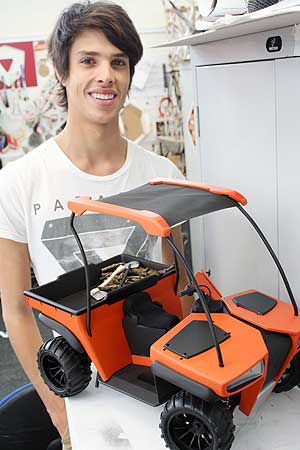
Industrial design student Tom Marshall wants to reduce the alarming injury toll from people riding quad bikes and believes a couple of key modifications he has made to the existing farm quad bike design could help realise that goal.
The 22-year-old has designed the Huntaway, a prototype model of a quad bike that features a roll-cage-type rooftop and a seat that locks in at what would otherwise be the bike’s tipping point.
More than 800 people are injured on farms riding quad bikes on farms every year in New Zealand. So far there have been five fatalities in 2012.
The Labour Group of the Ministry of Business, Innovation and employment has expressed a commitment to reducing the number of injuries and fatalities caused by quad bike accidents - something Mr Marshall wants to achieve with his design.
The Huntaway acts as an interim between farm ute and a farm bike, he says, and would be ideal for small jobs like fixing fences.
"The Huntaway bike has been developed specifically for farmers on their farms and has involved direct input from farmers within the design process," he says using an online community of farmers for feedback.
Mr Marshall believes with its roll cage, and the potential to eventually be fully enclosed, the Huntaway would be of interest to users outside the rural environment including the military and Department of Conservation workers.
"The bike is a safer alternative to the quad bike whereby the Huntaway’s design enables riders to be enclosed, important equipment to be transported more efficiently and applies physical feed back when pushed in terrain it cannot handle."
Its other key modification is the way it addresses the issue of weight distribution. Riders can be buckled into the seat, which allows their body weight to be shifted around to match the direction being driven - in a similar sensation to riding a motorcycle -, but the seat then locks when it senses the bike may overturn.
He has attempted to counter differences in industry opinion as to the merits or dangers of riders being buckled in by seatbelts to design his seat so that it does move from side to side.
"The seat is able to lean side to side to a point of 15 degrees each way. This swivel point is located near the base of the seat to enable effective movement of mass. This movement of mass improves the performance of the quad bike especially when cornering and moving along slopes."
Mr Marshall’s design also lowers the centre of gravity, with horizontal engine pistons fitted that move from side to side rather than up and down, while the gap between the body of the quad bike and its wheels has also been reduced.
Other modifications include a light all-weather sail cloth-type fabric roof top and a ‘step-through’ design for the swivel seat, rather than the traditional design which involved the rider putting one leg over the seat before sitting down.
Mr Marshall, who is of Ngai Tahu descent, says he became interested in addressing quad bike safety after time as a casual worker on farms during his summer holidays. ‘It’s something everyone was talking about wherever you went on the farm."
His design features from Saturday November 10 at Exposure an annual showcase of work by emerging young artists and designers from Massey’s College of Creative Arts, which traditionally opens the BLOW creative arts festival.
Fellow student, Nick Marks, from the Albany campus, has also worked on a quad bike design, specifically to counter control loss. His design, with the capability of shifting the vehicle’s centre of mass to keep a low centre of gravity preventing it from overbalancing, is part of is part of Design Exposure being held at Auckland as part of the BLOW.